
Still signals of strong investor appetite in cycling 

Recent news suggests that investors have not lost interest in bicycles and cycling more broadly. Private equity firms and other investors had turned away from the bicycle industry following the troubles at Accell Group, Rad Power, VanMoof, Scott Sports, and many others. Now, however, there are positive signs that bicycles, as a mobility solution, remain financially attractive. While insolvencies across the supply chain dominated headlines in the fourth quarter of 2025, 2026 has already brought several encouraging indicators.
Wireframe hands holding screen

Donkey Republic round signals strong investor appetite in cycling

The latest financing round of Bike sharing operator, Donkey Republic's initially set out to raise DKK 15-30 million (€2-4 million), but due to strong interest, the transaction was over-subscribed and the amount raised was upsized to DKK 75 million (€10 million).

The latest investment round is supported by a consortium of four new investors, including Nordic Compound Invest and Avium, as well as four existing shareholders, including BankInvest and Sagitta Investments. The management team members, including CEO Thor Möger Pedersen and COO Signe Storgaard Sørensen, are also participating with a total of DKK 0.5 million (€67,000). The additional capital strengthens its position to execute future rental fleet expansion and will enable Donkey Republic to lower its cost of capital.

8,000 new bikes

The capital raise was initiated to operate bike-sharing systems in the city of Düsseldorf and the Ruhr region. These contracts involve deploying over 8,000 bikes in 2026. “Our 'Ride and do well' strategy provides a clear roadmap to profitability,” comments CEO Thor Möger Pedersen. “The cost-efficiency measures and streamlined operating model introduced late 2025, combined with our recent commercial success, have resonated strongly with the investment community.”

The company is now preparing for uplisting from the Nasdaq First North Growth Market Copenhagen to the Nasdaq Main Market. The transition is planned for this year. “This transition is expected to broaden our investor base, enhance liquidity, and support a more institutionalised investor relations profile,” explains Thor Möger Pedersen. “We do not expect a negative impact from the uplifting, as the latest financing round significantly bolstered our financial position.”


Fundracer investment enables bicycle airbag market roll-out

The micro-mobility investment fund Fundracer announced an undisclosed investment in Belgian startup Aerobag, which is pioneering ultra-lightweight, compact airbag technology designed specifically for cyclists. Aerobag set out with a clear and ambitious mission: to adapt proven airbag technology from the automotive industry into a form factor that works for cycling.

“Over the last few years, my mission has been very simple,” said Bert Celis, founder and CEO of Aerobag. “I wanted to develop technology that truly protects cyclists, both professional athletes and everyday riders. If you really think about it, it’s crazy that we send pro riders down mountains and everyday riders into traffic with almost no protection. Aerobag solves this with a small, powerful system that the rider almost doesn’t notice, until it is there to protect you.”

Breakthrough thanks to artificial intelligence

A key enabler of Aerobag’s breakthrough is artificial intelligence. This allows the system to recognise crash scenarios in real time, something that has been refined for decades in the automotive industry but only recently became feasible for cycling due to advances in computing power, algorithms, and miniaturisation.

A big advantage of the Aerobag over the well-known but very expensive Swedish inflatable helmet Hövding is the reusability. The Hövding is single-use only, while the Aerobag can easily be reused and is designed for a single deployment per CO2 cartridge. After activation, the cartridge needs to be replaced. The textile system itself is designed to recover its shape after impact.

“We have previously invested in Blubrake (ABS), Luna Systems (AI video detection), and now in airbag technology for two-wheelers. Our strategy is to bring automotive safety technology to the micro-mobility market to enhance bicycle safety, among other benefits. The airbag was still missing from that list of safety technologies,” says Fundracer Partner René Wiertz.


Powerful investor secures insolvent Sprick's long-term future

As part of a share deal with Asian Tri Star Inc. (Tri Star Group), the lifting of the insolvency proceedings paved the road for a restart of the more than 100-year-old traditional company, Sprick. It has been a long and tough ride for the responsible insolvency administrator, Axel Geese from Streitbörger PartgmbB. Since the traditional German bicycle producer Sprick Rowery (aka Sprick Cycle) filed for insolvency at the end of 2024, Geese has been searching for someone to revive the long-established bicycle manufacturer.

Tri Star Group is taking over all Sprick Group companies. “With the integration of Sprick, we will further strengthen and strategically round off our industrial value chain, thereby creating a strong foundation for sustainable, long-term growth,” explains Tri Star Group’s Legal Counsel Stacy Zhang.

Sprick Group’s new investor, Tri Star Group, is headquartered in Shanghai, China. This company belongs to the multinational, Singapore-based conglomerate Dutech Holdings Ltd. (Dutech Group). Dutech was earlier announced as the investor of Sprick Rowery in September 2025. “With the entry of a strong, globally positioned investor such as Tri Star Group, Sprick Rowery is riding into a sustainable future. The intensive cooperation of all parties involved has made this important step possible,” underlines a quite relieved Geese. Under Tri Star Group, the traditional German bicycle group is said to act as a full chain supply provider from now on.

Polish production site remains unchanged

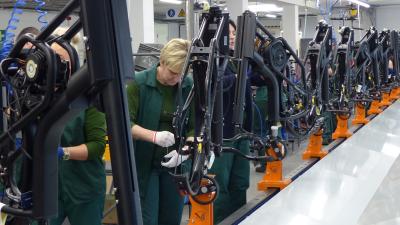
Sprick Rowery Spółka and its approximately 250 employees will remain fully intact. Thanks to its close ties to its new Asian parent company, Sprick Rowery will benefit from better logistics chains and optimised risk management in order to avoid dependencies on major customers, which recently led to financial difficulties.