spacer
Europe’s bicycle market is increasingly fragmented as national markets face uneven conditions in 2025. France and Switzerland are reporting prolonged market pressures stemming from declining sales and residual post-pandemic corrections. Meanwhile, Austria shows signs of stabilisation, and Belgium is a standout with strong growth driven by leasing, e-bikes and stable commuter demand. Across the four nations, consumer behaviour, subsidy policy and inventory issues appear to be the key factors dictating market success.

All indicators for the 2025 French market were negative. The total market volume decreased by 6%, while the revenue was down 4.8% year-on-year. The average retail price declined slightly, and the e-bike sales dropped 16%. This contraction comes amid a challenging economic environment but also reflects a more structural shift: the end of the post-Covid catch-up effect and the withdrawal of purchase incentives.
“When you boost a market with subsidies and then remove them, a slowdown is inevitable,” explains Patrick Guinard, president of the cycling commission at the industry organisation Union Sport & Cycle, during the presentation of the 2025 Cycle Observatory.
The French bicycle market generated a total revenue of €3.11 billion, down 4.8% year-on-year, in bicycles accessories and repair. Bicycle volumes totalled 1,836,000 bikes, down 6% and the average price stands at €1,014 (-1%). That said, the sector has not dipped to its pre-Covid starting point. The market remains 23% above its 2019 level, confirming that cycling has become firmly embedded in French habits — despite recent setbacks. Even more notably, usage of cycling infrastructure continues to grow (+5% on average).
Bicycle sales in Switzerland declined for the fifth consecutive year in 2025. At 316,050 bicycles, the number of bikes delivered to retailers was the lowest since 2008. Admittedly, the decline at 7.4% has slowed significantly compared to the previous two years. Every day bicycles, both with and without electric assistance, clearly lost ground, each by a good 10%.
The overall decline was cushioned by sports bikes without accessories, which saw a rise of just under 1.6% in the non-motorised versions, primarily due to gravel bikes, which increased by 34% to 21,702; road bikes also contributed to the increase. Overall, the number of e-sports bikes remained almost stable at 46,377, but in total, the electric segment saw a 14% decline in 2025. Even cargo bikes, long considered ‘trendy vehicles,’ experienced a similar downturn of just over 12%. As a result, the e-bike share dropped from 45% to 41%. Speed pedelecs continued to decline, down 9% to around 19,000 units.
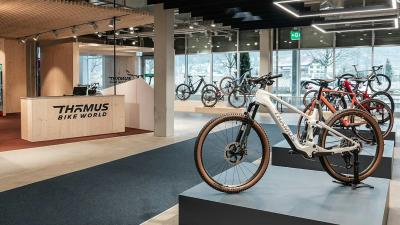
Different trends emerged between specialist retailers and major distributors. Following Thömus’s majority takeover of Bike World from Migros, thousands of bicycles and e-bikes were heavily discounted onto the market between September 2024 and February 2025. This likely contributed to a renewed downturn among major retailers across all segments, particularly urban and sports e-bikes, both down over 40%. Major retailers have therefore lost almost 24% of their market share.
After several challenging years for the bicycle industry, the Austrian industry and market proved remarkably stable in 2025. In 2025, Austria's bicycle and sporting goods retail sector sold approximately 389,000 units, a slight 1.7% decline compared to 2024. The figure refers to sell-in volumes delivered to specialty retailers, not end-consumer sales.
The market volume remained below 400,000 units for the second consecutive year after peaking above 500,000 during the pandemic boom. Of the total volume, 166,270 were bicycles and 222,730 e-bikes, pushing the e-bike market share to a new high of 57.3%. Thanks to e-bikes, Austria’s bicycle industry reached a new record average price of €2,821, up 5.7%.
According to ARGE Fahrrad, inventory levels stabilised in 2025 following intensive clearance sales in 2024, with far fewer discounting measures required last year. The association also noted that sales through domestic bicycle and sporting goods specialty retailers continued to rise, while sales through discount retailers declined.
Contrary to almost all other European countries, the Belgian bicycle market is performing very well. After the 2022 peak, the market bounced back to a pre-pandemic level, and has not been affected by the sustained decline seen in Germany, Italy and the Netherlands. In 2025, the Belgian market even experienced a 7.1% increase to 578,737 units in total. What made this Belgian miracle?
Just like all over Europe, a large stock had been built up in 2023, but this was seemingly absorbed easily by the market. E-bike sales remain stable, and speed-pedelecs are still an important driver for the market. Especially during the first half of the year, e-bike sales performed very well. Growth was in double digits through August, with March and April in particular posting 27.8% and 27.6%, respectively. The road bike is recovering, and the fatbike is capturing nearly 1% of the market.
“The 2025 figures confirm that the bicycle is not just an alternative to a car, but a fully-fledged means of transport for both commuting and leisure,” says Filip Rylant, spokesperson for Traxio. “Moreover, we notice that Belgians are still willing to purchase a new bicycle and are increasingly and consciously choosing quality that suits their daily mobility needs. The rising share of new bicycle lease contracts and the growing number of kilometres people cycle confirm this trend.”
Search, through all Editions